
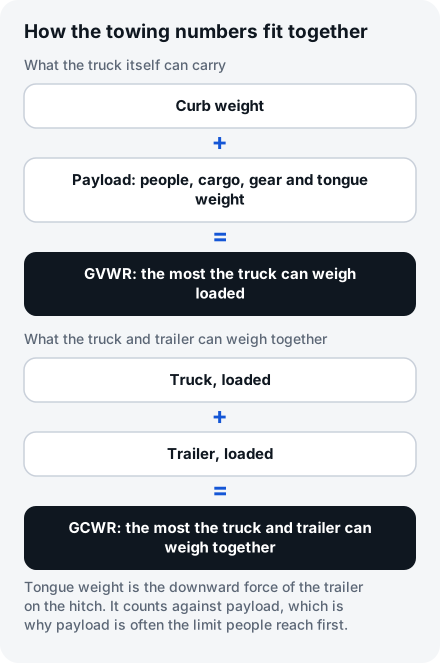
The terms, in plain language
- Curb weight: the weight of the truck as it sits, without people or cargo.
- Payload: how much weight of people, cargo and gear the truck can carry.
- GVWR (gross vehicle weight rating): the most the truck itself can weigh when loaded.
- GCWR (gross combined weight rating): the most the truck and trailer can weigh together.
- Tongue weight: the downward force the trailer puts on the hitch.
- Towing capacity: how much trailer the truck can pull, within the limits above.
Tongue weight uses up payload
Tongue weight counts against your payload. A heavy trailer puts a real load on the hitch before you add passengers or gear. That is why payload is often the limit people reach first.
Ratings depend on how the truck is equipped
Towing and payload vary with the engine, axle ratio, cab, bed and tow package. The number for a model is not the number for every truck. Check the sticker in the driver's door jamb for the truck you are buying, and ask the dealer to confirm the ratings for that exact vehicle.
Leave a margin
Many experienced towers keep their loaded trailer well below the maximum rating. Hills, wind, heat and shifting loads all add stress. If your trailer is near the limit of a half-ton truck, a heavy-duty truck may be the better fit.
Questions to ask before you buy
- What are the payload and towing ratings for this exact truck?
- Is a tow package included, and what does it add?
- Which engine and axle ratio suit my trailer?
- How heavy is my loaded trailer, and what is its tongue weight?
. By Tony Tribble, Ballas Chevrolet. General information, not legal or tax advice. Rules vary by state.